
By Andre Yeu, Founder of When Hound Fly
How to Stop Your Dog From Barking Using Positive Reinforcement
If you’ve landed on this page, there’s a good chance you’ve already tried a few things. Maybe you’ve raised your voice, tried ignoring it, or gone down a rabbit hole of “quick tips” that didn’t stick. Knowing how to train a dog not to bark is one of the most searched questions in dog training, and most of the answers out there are too simple to actually work. Before we talk about what does work, let’s talk about the single most common mistake I see dog owners make.
They yell at their dog to stop barking.
Here’s the problem: from your dog’s perspective, you just joined in. You barked back. And now you’re both barking, which means one of you is having a great time and it isn’t you.
Getting angry and yelling at a barking dog does not help in any situation, for any type of barking. It’s the universal starting point for making things worse. So if that’s been your go-to, you’re not alone, and it doesn’t make you a bad owner. It just means nobody ever explained what’s actually going on.

Barking Is a Symptom, Not the Problem
Here’s the reframe that changes everything for most of my clients: barking is not the problem. Barking is a symptom of an unmet need.
That need might be physical exercise, mental stimulation, safety, security, or connection. Sometimes it’s a combination of all of them. And sometimes, honestly, it’s just the dog being a dog. A guardian breed that barks when strangers approach the house? That’s not a bug. That’s a feature. Thousands of years of selective breeding don’t disappear because it’s inconvenient at 7am.
Looking for a quick tip to stop barking is a bit like looking for a pill that gives you perfect health. Perfect physical health requires a holistic approach: diet, sleep, exercise, mental stimulation, and connection. Behavioural health works exactly the same way. If you’re treating the symptom without understanding the cause, you’re going to be frustrated, and your dog is going to find another way to tell you something is wrong.
Why Punishment Doesn’t Work (And Can Make Things Worse)
I want to address this without being preachy, because I know many of you have considered it, or already tried it.
Bark collars, spray bottles, shake cans, and similar tools share the same fundamental flaw: they don’t address the underlying issue. If your dog is barking because they’re bored or frustrated, suppressing that barking with punishment is likely to push the behaviour somewhere else. Chewing furniture. Chewing their own paws. Redirected anxiety that’s harder to see and harder to treat.
There’s also a practical problem. Punishment requires consistency and precise timing to have any effect at all. I’ve heard trainers recommend throwing a bean bag full of coins at a barking dog. Some even suggest water balloons. I’d like to ask those trainers: who has a water balloon ready to throw with perfect timing, 24 hours a day, 7 days a week? Because your dog is barking at 6am on a Tuesday and you are half asleep in your housecoat.
Punishment is not a system. It’s a reaction. And reactions don’t train dogs.
Case Study One: The Springer Spaniel Who Just Needed to Run
One of the most common barking problems I work with is demand barking at home, and one case sticks out as a perfect example of why you have to look beyond the barking itself.
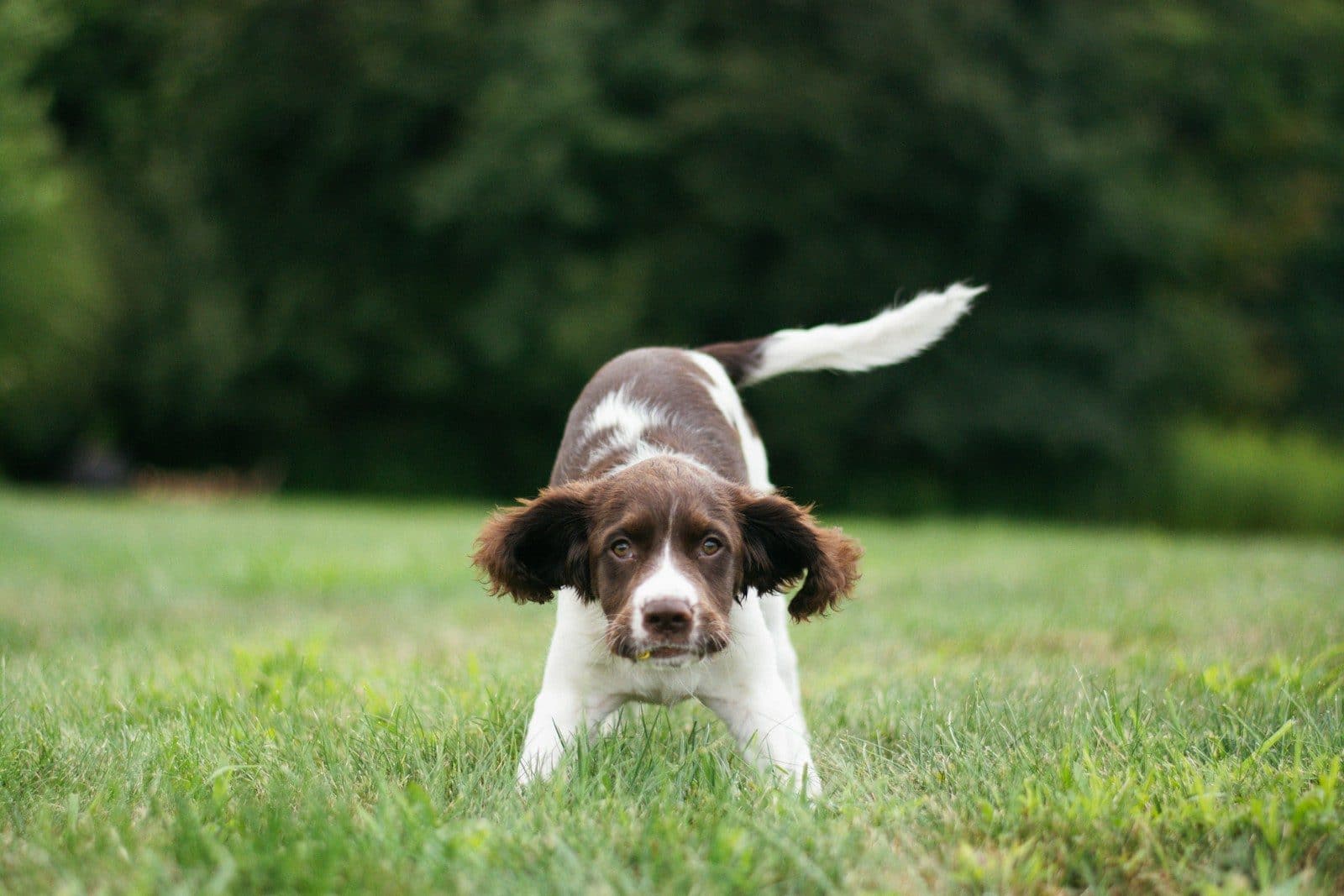
I had clients with an adolescent Springer Spaniel who would bark at them relentlessly in the evenings, especially around dinner time. They were switched-on owners. They understood positive reinforcement. They had actually tried to cue the dog to go to his mat and stay there while they ate, rewarding him with treats for settling.
The problem was the sequence. The dog would bark, they would cue the mat, and the dog would get reinforced. From the dog’s perspective, barking was the behaviour that started the whole chain. They were accidentally reinforcing the barking.
But here’s where it gets more interesting. When I started asking about the dog’s overall lifestyle, I found out he was never allowed off leash. Not once. This is a Springer Spaniel. A breed built to run through fields all day. He had an enormous physical and mental energy deficit, and the barking in the evenings was the overflow.
We added off-leash time at a local dog park. The evening barking settled dramatically. Not because we trained the barking away, but because we addressed the actual problem.
Case Study Two: The Window Is Not a Hobby
The second type of barking I work with constantly is alert barking, and the case I think about most involved a small dog who had spent years barking at people and other dogs passing by the front window.
When I explained what was happening, the owner understood the mechanics well enough: the dog barks at the perceived threat, the threat moves along (because they were always going to move along), and the dog’s brain logs that as a win. The barking worked. Thousands of repetitions of that sequence had made the behaviour rock solid.
The practical solution was straightforward: rearrange the furniture so the dog couldn’t access the window. Remove the opportunity.
The owner pushed back. She felt the dog “enjoyed” it. That the window was her hobby, and we’d be taking something away from her.
This is one of the most important conversations I have with clients, so I want to be direct about it here. A dog spending hours alone at a window, in a state of repeated alarm, is not enjoying a hobby. She is stressed. She is on edge, scanning for threats, flooding her own nervous system with cortisol over and over again while her owner is at work. She needs to be resting. What looks like engagement is often chronic low-grade anxiety, and it is not a kindness to leave it in place.
You can train for a few minutes a day. You cannot out-train eight hours of daily rehearsal. The window is the perfect 24/7 training system for barking. The most effective intervention is to switch it off.
What Positive Reinforcement Actually Looks Like for Barking
So how do you train a dog to stop barking using positive reinforcement? The honest answer is that it depends entirely on why the dog is barking. But the approach is always the same: identify the root cause, address the unmet need, and build an environment where calm behaviour makes sense to the dog.
Positive reinforcement is not about bribing your dog into silence. It’s about building an incompatible behaviour, addressing the root cause, and setting up the environment so the dog is set up to succeed.
Depending on the type of barking, that might look like:
For demand barking: Identify what the dog is asking for and build a system where calm behaviour, not barking, predicts access to good things. Too many owners ignore their quiet, settled dog for hours, and then only when their dog starts barking, do they pay any attention. This is why protocols such as Kathy Sdao’s SMARTx50 are so powerful – they teach people to see their dog being quiet and then reinforce them. Critically, audit the lifestyle. Is the dog getting enough physical exercise? Off-leash time? Mental stimulation? Barking at you in the evening is often the bill coming due for a deficit that built up over the day.
For alert barking: Manage the environment first. Remove or reduce access to the trigger while you work on the behaviour. Teach a “go to place” cue that the dog finds genuinely rewarding, and practice it when the dog is calm before you ever try it in the presence of a trigger. When your dog hears a noise in the hallway or outside and barks, cue your dog to go to their place, and reward them. Over time, instead of losing their mind and barking for a long time, your dog will learn to bark once (or skip barking completely) and go their place and be quite happy about it. Kiki Yablon’s Thank You For Barking protocol covers this in more detail.
For reactivity: Barking is just an expression of the fear or frustration that your dog feels when they see a trigger in the world (such as other dogs). By doing reactive dog training in Toronto, using techniques such as Engage-disengage, or Control Unleashed exercises like Up and Down or Superbowls, and later doing group walks for reactive dogs, the barking will diminish over time.
For all barking: Look at the whole picture. Sleep, exercise, social connection, mental enrichment, and safety. These are not nice-to-haves. They are the foundation that everything else is built on.
A Note for the Owner Who Is Exhausted
If you’ve tried everything and you’re starting to wonder if your dog is just broken, I want to say something clearly.
Barking is normal in dogs. What’s not normal is non-stop barking, or barking that sends the dog into a prolonged state of emotional dysregulation they can’t come back from. If that’s what you’re dealing with, the problem is real, and it deserves a real response.
Stop taking advice from people who offer quick tips. Start working with a qualified dog training and behaviour consultant, someone who tells you upfront that this isn’t simple, and who starts by asking questions about your dog’s whole life before they prescribe a single solution.
It’s also worth noting: if your dog’s barking is paired with lunging, snapping, or growling, you may be dealing with something that crosses into aggressive behavior. Aggression behavior dog training is a different and more involved process, and it’s especially important not to rely on punishment-based approaches in those cases. A qualified behaviourist can assess what’s actually going on.
Your dog isn’t broken. But they are trying to tell you something. The job is figuring out what.
Andre Yeu is the founder of When Hounds Fly, a positive reinforcement dog training school with locations across the Greater Toronto Area. When Hounds Fly has helped thousands of dog owners build better relationships with their dogs through science-based, humane dog training.