
If you’ve ever come home with a sore shoulder, rope burn on your palm, or just a deep sense of dread before you even clip the leash on, you’re not alone. Leash pulling is one of the most common issues we hear about from dog owners across Toronto, and it’s also one of the most fixable, once you understand why it’s happening in the first place.
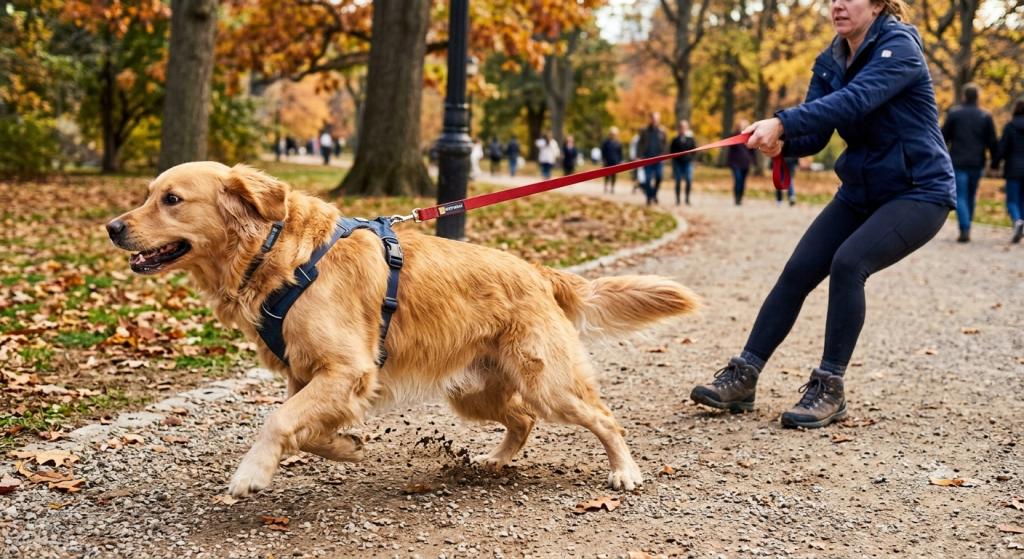
The good news? This isn’t about dominance, “alpha” status, or your dog trying to be the boss. It’s about biology, reinforcement history, and a few simple training principles that, once applied consistently, can completely change your walks.
Why Dogs Pull on the Leash (Even Good, Well-Exercised Dogs)
Here’s something that surprises a lot of new clients: almost every dog will pull on leash at some point, even dogs whose needs are fully met. Exercise, enrichment, safety, mental stimulation, none of that changes the fact that dogs naturally walk faster than humans, especially once they hit adolescence.
An under-exercised dog will absolutely be harder to train, but the core issue isn’t a lack of tired-out energy. It’s pace. Your dog wants to move at their pace, and you’re moving at yours.
Here’s what actually happens: your dog walks ahead, hits the end of the leash, and feels the collar or harness tighten. That sensation triggers something called the opposition reflex, an instinctive pull against pressure. Then, because that pull often results in forward progress (you take a step, or you let them gain a few inches), the behaviour gets reinforced. The harder they pull, the more it “works.” And the cycle builds on itself, walk after walk.
Understanding this is the first step toward fixing it. Pulling isn’t defiance, it’s a reflex being reinforced by accident, over and over again.
How to Train a Dog Not to Pull on Lead: The Method That Actually Works
When clients ask how to train a dog not to pull on lead, they’re often expecting a quick trick or a piece of equipment that “fixes” it overnight. The truth is, lasting change comes from teaching your dog a new default: that staying near you and checking in is more rewarding than charging ahead.
Here’s the process we use in our Foundation Skills program:
Step 1: Build Engagement First
Before you even think about walking, teach your dog that paying attention to you is worth their while. We use a clicker to mark the moment your dog makes eye contact or checks in, followed immediately by a food reward. Treats are convenient, easy to deliver quickly, and let you reinforce frequently, which is exactly what you need in the early stages.
Step 2: Make Movement Part of the Game
Once your dog is reliably offering attention, start moving, forward, side to side, even backward. Movement naturally triggers your dog to follow and re-engage, and every time they do, click and treat. At this point, you’re already about 90% of the way to a loose leash walk.
Step 3: Stop When They Pull
This is the piece most people get partially right but apply incorrectly: when your dog pulls ahead, stop moving. Don’t reinforce pulling with forward motion. But here’s the catch, if stopping is the only thing you do on a walk, the whole experience becomes frustrating for both of you and you’ll go nowhere, literally. Stopping needs to work alongside Steps 1 and 2, not replace them.
Step 4: Fade the Food Over Time
As the habit builds, your dog starts to associate walking at your pace with good things happening, forward movement, sniffing opportunities, access to the environment. Gradually, you can reduce the food rewards because the walk itself becomes reinforcing.
Equipment: What Helps, and What Doesn’t (Long-Term)
A lot of owners ask us about gear before anything else, and equipment can absolutely help in the short term. But it’s important to know what each tool actually does, and where it falls short.
Front-Attachment Harness
Removes the collar-tightening sensation that triggers opposition reflex, giving you some relief early on. The downside: some dogs learn to lean into the harness and pull sideways at a 45-degree angle, so it’s not a permanent solution on its own.
Head Collars
Can stop pulling momentarily by redirecting the head. We rarely recommend these, as we’ve seen dogs learn to pull through them over time, just like any other tool that isn’t paired with actual training.
Prong Collars
We do not recommend prong collars for pulling. While they may stop pulling initially, we’ve personally worked with dogs who learned to pull through them anyway, despite the discomfort. Like other quick fixes, they don’t address the underlying behaviour.
Bungee or Flexi Leashes
These take strain off your wrists and shoulders, but they make it nearly impossible for your dog to learn where the “end” of the leash is, since that length keeps changing. Often, pulling hard just gives them more range, reinforcing the very behaviour you’re trying to stop. We don’t recommend bungee leashes for training (except in specific cases involving a handler’s medical needs), and flexis are better suited to giving dogs freedom to roam in open areas, not for structured walks.
Three Mistakes Owners Make (Before They Call a Trainer)
1. Holding the Leash Tight
This one is personal. As a brand-new dog owner, I thought “walking by your side” meant physically holding the leash tight to keep my dog close. He was still pulling, just six inches from my leg instead of six feet. The leash needs to stay slack for loose leash training to actually work. A tight leash teaches nothing except how to pull against tension.
2. Obsessing Over Position
Outdated dominance-based advice insists that a dog walking in front of you means they’re “leading” and asserting status. In reality, this is irrelevant. Having your dog slightly ahead is actually useful, you can see what they’re looking at, reacting to, or sniffing before it becomes a problem. Personally, I’d rather have a dog I can watch than one trailing behind me out of sight.
3. Training on the Wrong Leash
As covered above, bungee and flexi leashes work against you here. If you’re serious about fixing pulling, train on a standard, fixed-length leash so your dog can build a clear, consistent sense of where “the end” is.
How Long Does It Take?
Every dog and every owner is different. Some families see real change within a week or two of consistent practice on daily walks. Others, especially dogs with a high drive to get somewhere (the dog park, a favourite trail, another dog), take longer. For these dogs, food rewards may simply not compete with the payoff of getting there faster, and ongoing maintenance training through adolescence is often part of the plan.
That’s completely normal. The goal isn’t perfection on day one, it’s steady, reinforced progress that builds into a lasting habit.
Ready to Stop the Tug-of-War?
If you’re dealing with leash pulling and want a structured, proven approach, our Foundation Skills program includes our Walk with Me module, the exact framework described above. It’s designed to give you and your dog the engagement-based foundation that makes loose leash walking click, often faster than you’d expect.
Once your dog has the basics down, our Outdoor Loose Leash Walking class takes things further, helping your dog generalize loose leash skills in real-world environments full of distractions: other dogs, squirrels, traffic, and busy sidewalks.
Start Walking Better, Together
Whether you’re looking for dog obedience classes Toronto families trust, or searching for dog training Mississauga and dog training Markham residents recommend, our Foundation Skills and Outdoor Loose Leash Walking classes are here to help.